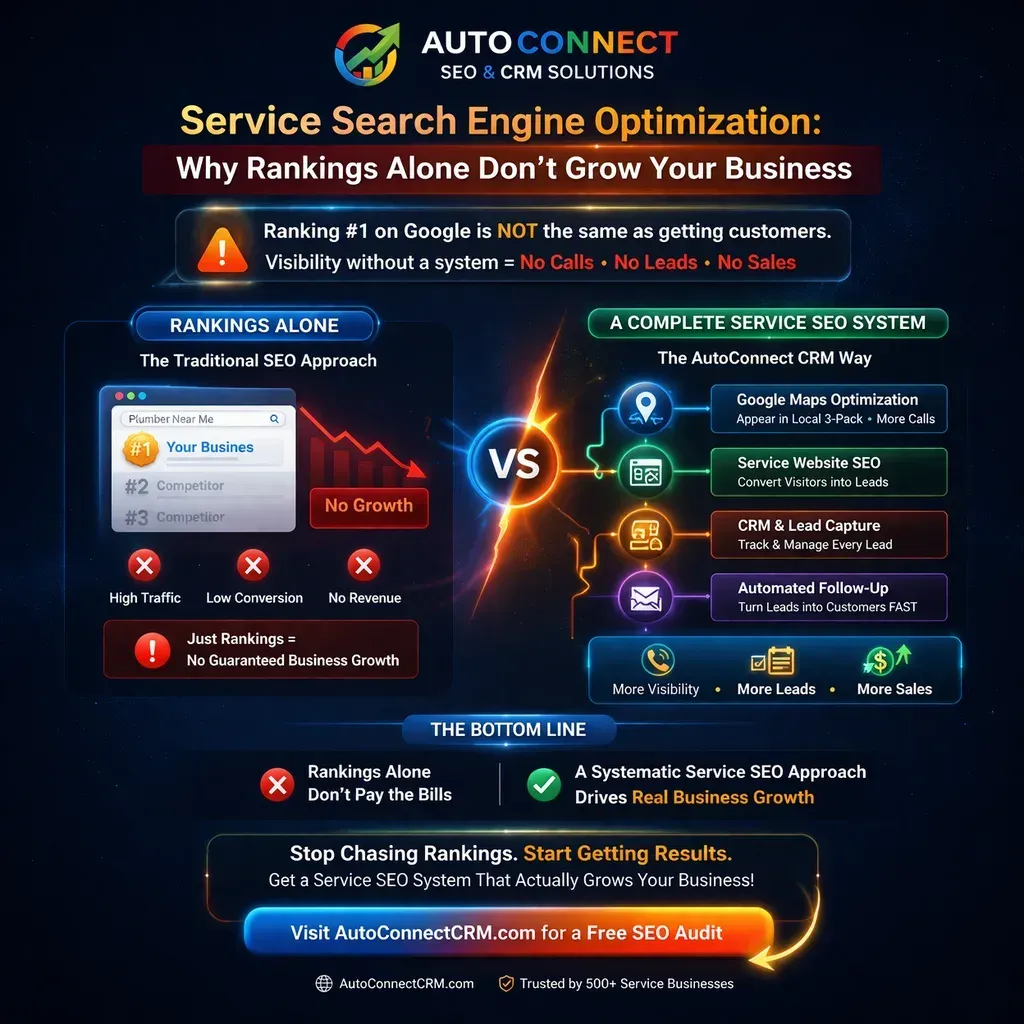
Service Search Engine Optimization: Why Rankings Alone Don’t Grow Your Business
Most businesses searching for service search engine optimization assume the goal is simple: rank higher on Google. That assumption is exactly what many agencies build their entire marketing pitch around. They promise improved rankings, more organic traffic, and monthly reports that show keyword movement. While those metrics might look impressive, they rarely tell the full story. The reality is that rankings alone don’t grow a business. Local service companies survive on phone calls, booked appointments, quote requests, and closed deals. If your service search engine optimization strategy isn’t generating those outcomes, then it isn’t working the way it should. The true purpose of service search engine optimization is not just visibility but revenue generation. This is the difference between traditional SEO agencies and the system-based approach behind AutoConnect CRM, where the goal is to connect search visibility with real lead generation and sales.
What Service Search Engine Optimization Actually Means
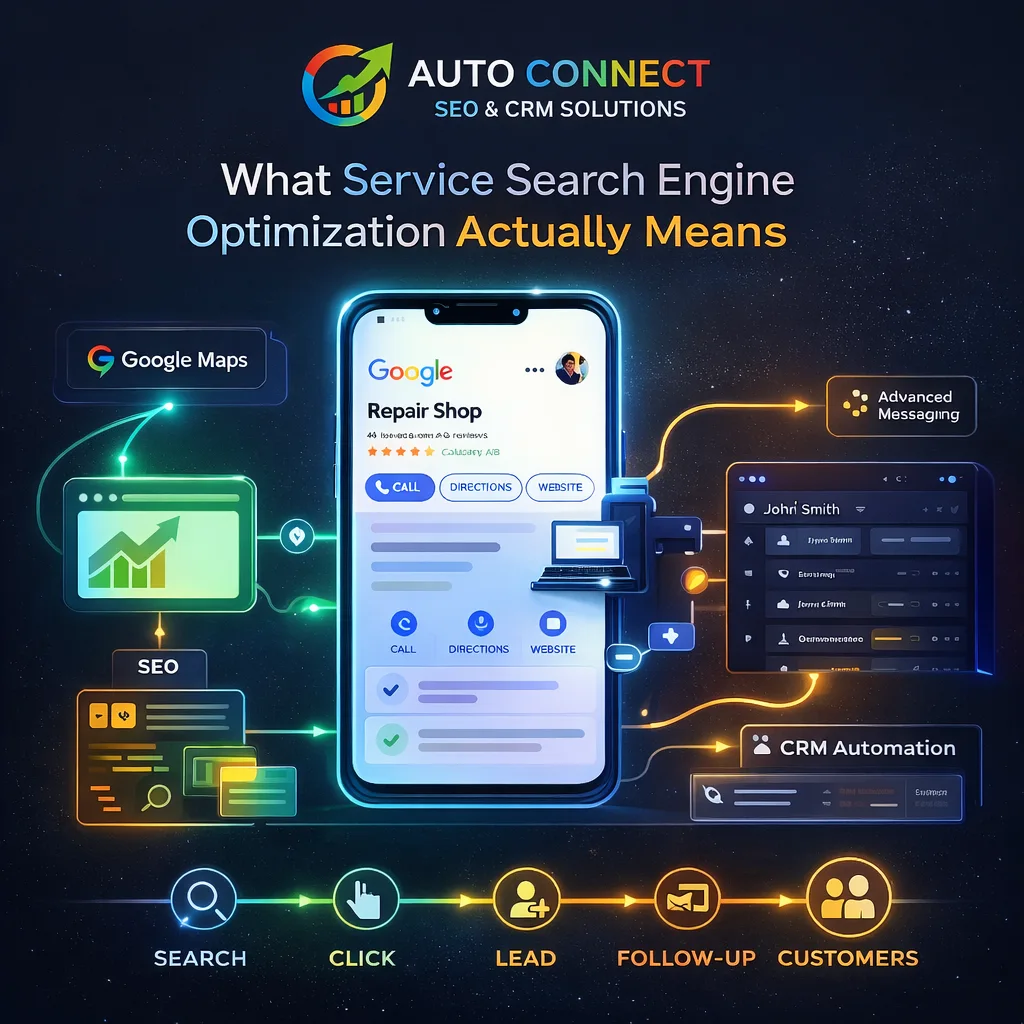
At its core, service search engine optimization is the process of helping businesses appear in search results when potential customers are actively looking for the services they offer. When someone searches phrases like “auto repair near me,” “Calgary plumber,” or “HVAC repair Calgary,” search engines analyze multiple ranking signals to determine which businesses appear first. Traditional SEO often focuses on optimizing websites, targeting keywords, building backlinks, and improving rankings. While these elements are important, they are only part of a much larger system. True service search engine optimization goes beyond ranking pages and instead focuses on the entire customer journey: search, click, lead capture, follow-up, and conversion. When businesses only focus on the first step—ranking—they miss the opportunity to convert that visibility into actual customers.
Why Most Service Search Engine Optimization Strategies Fail
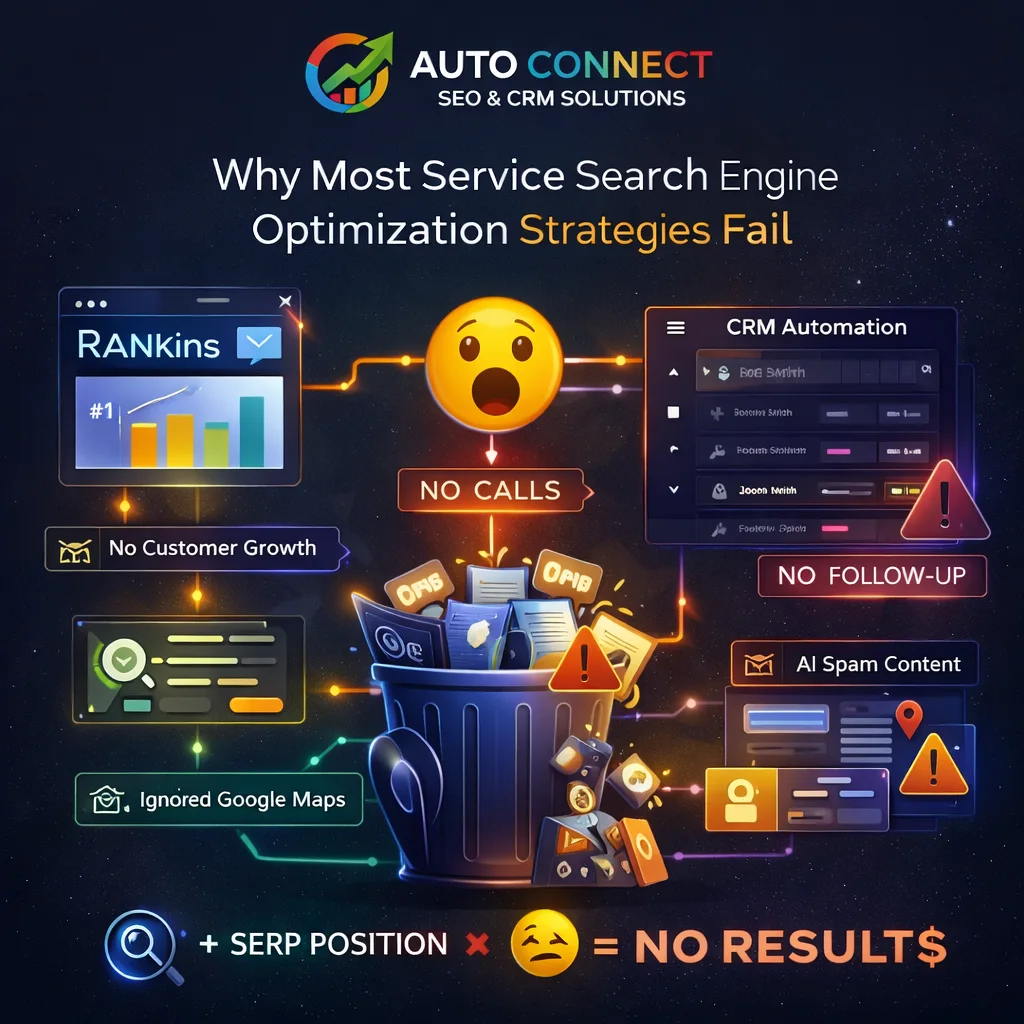
After working with many local businesses including automotive shops, service contractors, clinics, and gyms, one pattern becomes very clear. Companies invest in service search engine optimization, their traffic begins to increase, but their revenue barely changes. The problem is rarely the traffic itself. Instead, it’s the lack of a system behind that traffic. Without the right structure to convert visitors into leads and customers, even a successful service search engine optimization campaign can produce very little business impact. Several common mistakes explain why so many SEO strategies fail to deliver meaningful results.
1. Agencies Obsess Over Rankings Instead of Revenue
One of the biggest problems in the SEO industry is the obsession with rankings instead of business outcomes. Many agencies present reports showing keyword movements, traffic increases, and search impressions. While those metrics might demonstrate technical improvements, they rarely measure what actually matters to business owners. When a company invests in service search engine optimization, they are not buying rankings; they are buying growth. A business owner cares far more about whether their phone is ringing than whether a keyword moved from position five to position three. Without proper lead tracking, call tracking, and form submission reporting, service search engine optimization becomes little more than a vanity marketing metric.
2. Most Agencies Ignore Google Maps (Where the Calls Actually Come From)
For many local businesses, the majority of calls come from Google Maps rather than the website itself. When people search for services nearby, the first results they often see are the local map listings, also known as the Map Pack. These listings frequently generate more phone calls, directions, and website clicks than traditional search results. Despite this reality, many agencies treat Google Business Profile optimization as a minor task instead of a central part of service search engine optimization. Businesses that fail to optimize their Google Maps presence often lose valuable leads to competitors who appear higher in local results. Improving visibility in Google Maps is one of the most important components of modern service search engine optimization, especially for service-based companies.
3. Traffic Without Conversion Systems Is Useless
Another major issue with traditional SEO strategies is that they focus heavily on generating traffic without addressing how that traffic converts into leads. A website might receive hundreds or even thousands of visitors each month through service search engine optimization, but if those visitors do not turn into phone calls or form submissions, the traffic has little business value. Effective service search engine optimization must include clear lead capture systems, such as click-to-call buttons, contact forms, appointment booking tools, and fast mobile experiences. Without these conversion tools in place, businesses may attract visitors but fail to turn those visitors into paying customers.
4. AI Content Spam Is Destroying SEO Quality
Another challenge affecting modern service search engine optimization is the rise of generic AI-generated content. Many agencies now publish large amounts of automated content with minimal editing or expertise behind it. This approach might produce volume, but it rarely produces authority. When multiple companies publish nearly identical AI-generated articles, search engines struggle to identify real expertise. Businesses end up with content that lacks personality, experience, and credibility. Effective service search engine optimization requires real insights, practical knowledge, and useful information that demonstrates genuine authority within a specific industry.
5. SEO Is Treated Like a Setup Instead of a System
Many businesses purchase service search engine optimization as if it were a one-time setup. Agencies might build a few pages, add a handful of backlinks, and then send monthly reports showing incremental improvements. However, search engines are constantly evolving, and competition continues to increase. Real service search engine optimization requires ongoing effort through content creation, local SEO improvements, technical updates, and conversion optimization. Instead of functioning as a simple checklist, SEO should operate as a continuous system that drives visibility, captures leads, and improves conversions over time.
The System That Actually Makes Service SEO Work
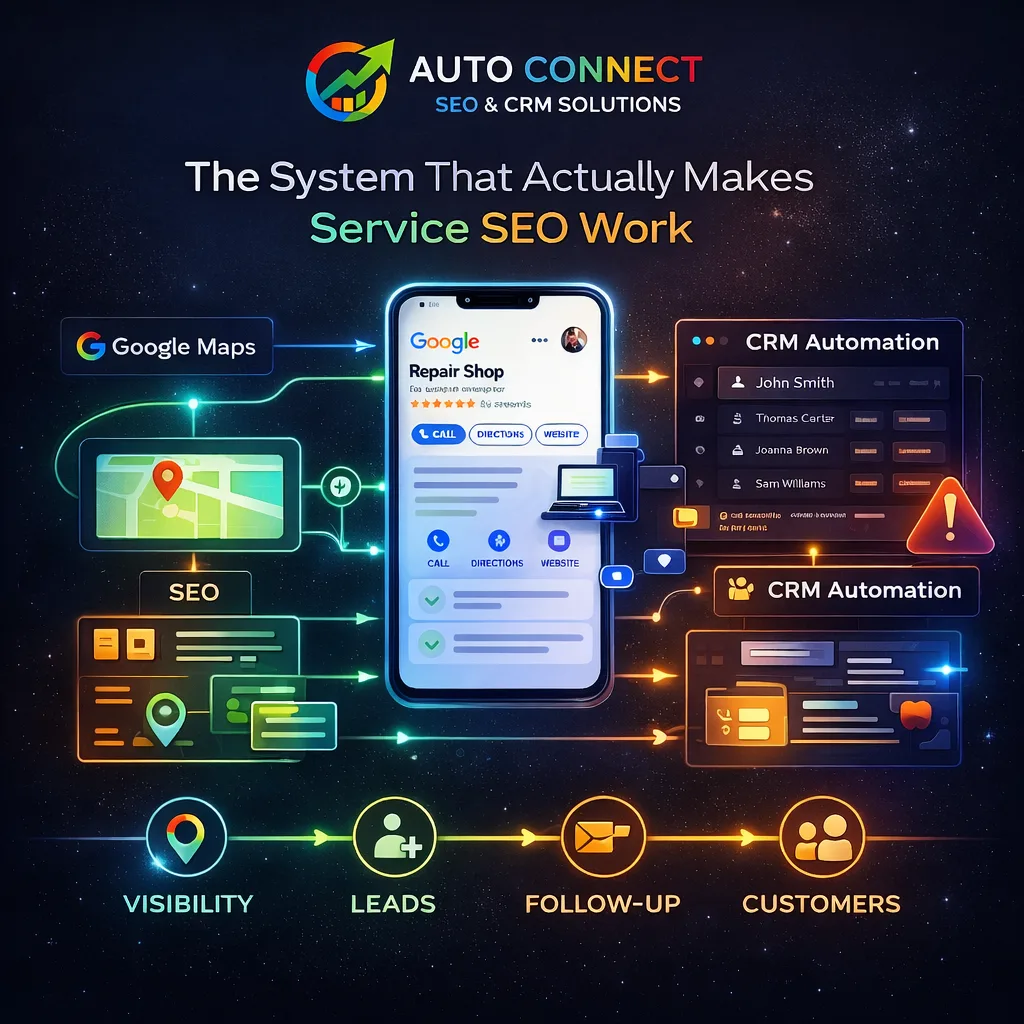
Understanding the limitations of traditional SEO is exactly why AutoConnect CRM was created. The goal was not simply to improve rankings but to connect service search engine optimization with lead generation and customer management. In this system, SEO generates visibility while CRM tools convert that visibility into real business results. AutoConnect CRM helps businesses get found online, capture leads, and close more sales by combining Local SEO, Google Maps optimization, and automated follow-up tools.
Step 1 — Local SEO and Google Maps Visibility
The first stage of effective service search engine optimization is ensuring that businesses appear in local search results when customers are looking for their services. This includes optimizing Google Business Profiles, improving Google Maps rankings, targeting location-based keywords, and building service pages designed for local search. These signals help search engines understand where a business operates and which services it provides, making it easier for nearby customers to discover them online.
Step 2 — Website SEO That Captures Leads
Once a business appears in search results, the website must convert visitors into leads. Strong service search engine optimization includes well-structured service pages, clear calls to action, click-to-call buttons, and easy-to-use contact forms. The goal is to ensure that every visitor has a simple path to becoming a lead. A website optimized for service search engine optimization should function as a lead generation tool rather than simply an informational brochure.
Step 3 — CRM Lead Tracking
One of the biggest challenges many businesses face after implementing service search engine optimization is managing incoming leads effectively. Without a centralized system, leads may be lost, forgotten, or poorly tracked. AutoConnect CRM helps businesses manage leads, customers, pipelines, appointments, and marketing campaigns within one platform. This structure transforms SEO traffic into organized opportunities and prevents businesses from missing valuable inquiries.
Step 4 — Automated Follow-Up
Fast response time is a major factor in converting leads into customers. Many potential customers choose the first company that responds to their inquiry. Modern service search engine optimization must therefore be connected with automated follow-up tools such as SMS responses, email automation, appointment reminders, and missed-call text-back features. These tools allow businesses to respond quickly and maintain consistent communication with potential customers.
Real Examples of Service SEO Systems in Action
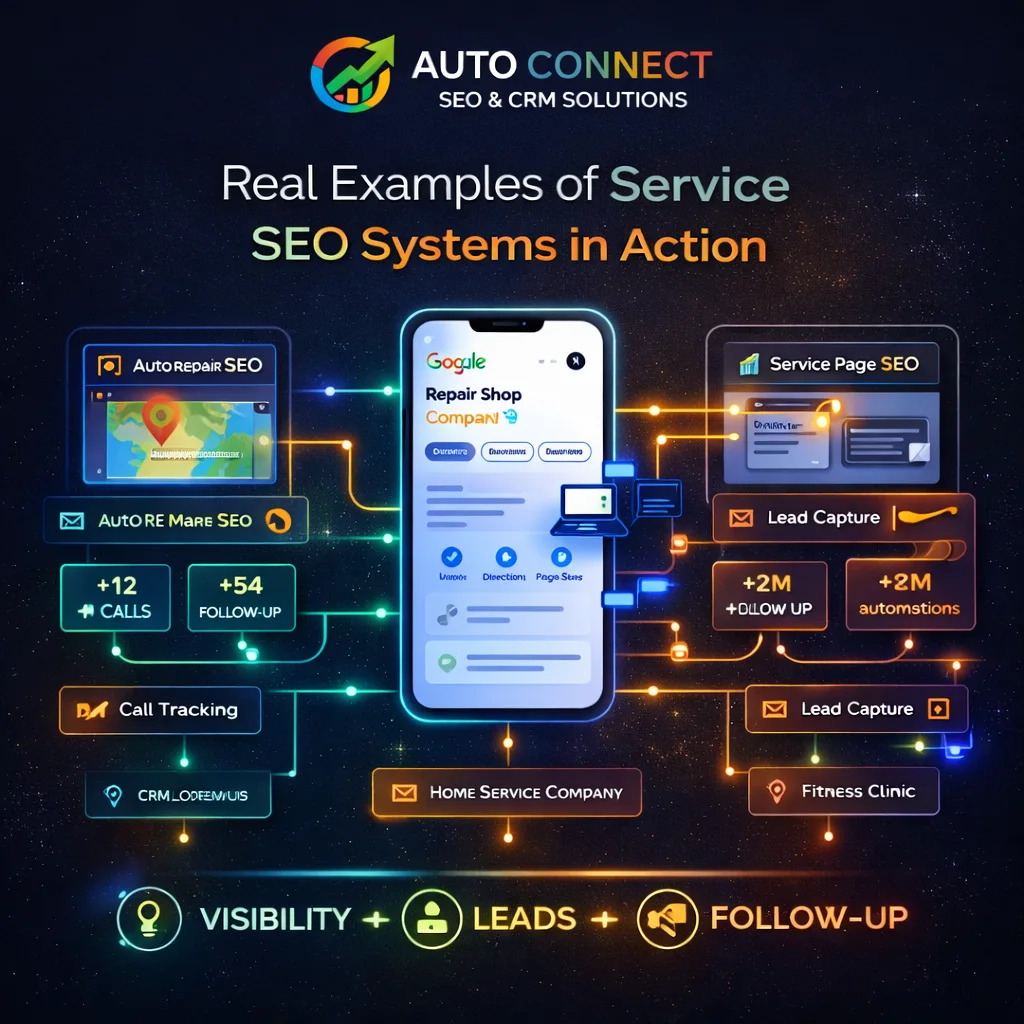
Real-world examples demonstrate how service search engine optimization performs when it is combined with a complete lead generation system. One example involved a local auto repair business that had a website and some organic traffic but received very few phone calls. After improving their Google Business Profile, optimizing service pages, and implementing CRM lead tracking, the business began receiving significantly more calls from Google Maps searches. Another example involved a home service company that relied heavily on paid advertising. By implementing a structured service search engine optimization strategy that included Google Maps optimization and automated lead follow-up, the company began generating more organic leads while reducing its dependence on paid ads. Similar improvements occurred with a local fitness and clinic business where optimized service pages and CRM-based lead capture forms helped increase form submissions and improve lead tracking.
Why Businesses Need a System — Not Just SEO
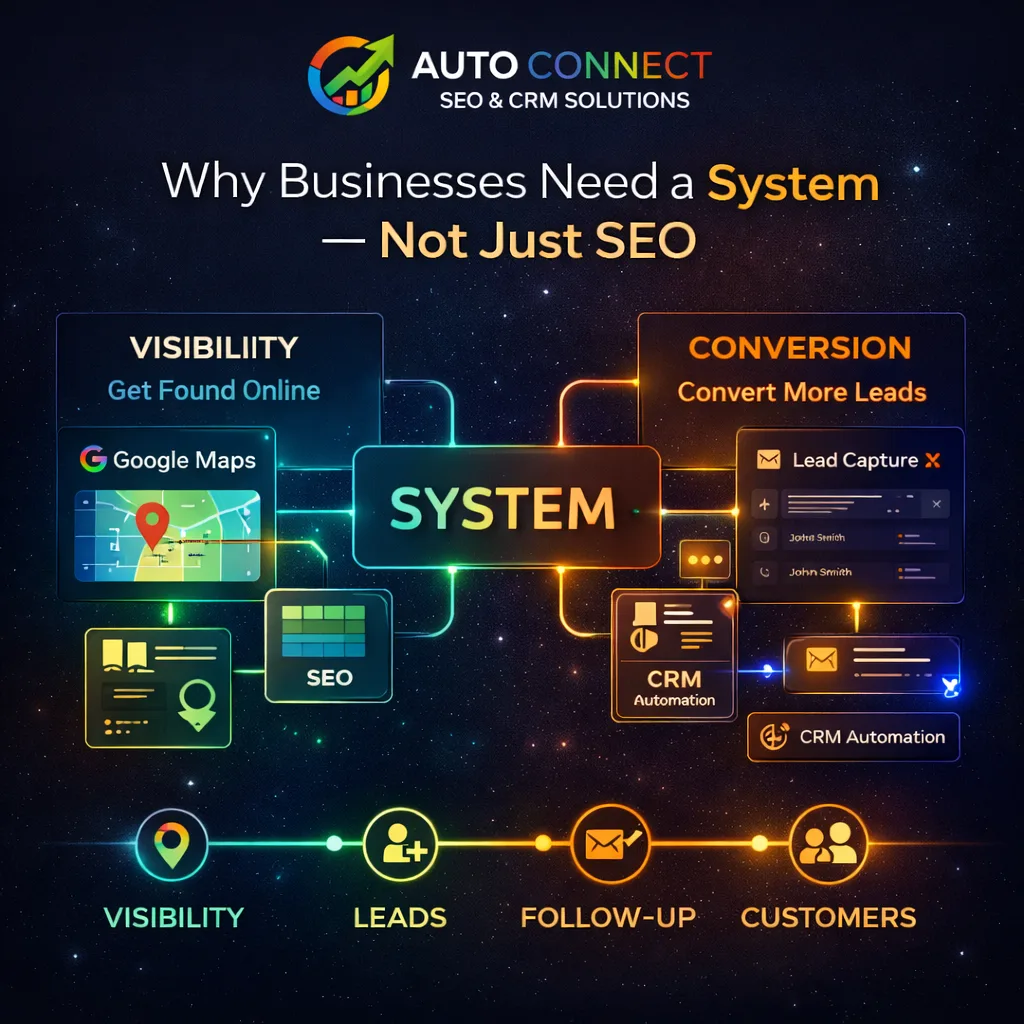
Businesses searching for service search engine optimization typically want more than higher rankings. They want more phone calls, more appointments, and more customers. Achieving those outcomes requires more than traditional SEO techniques. It requires a complete system that combines visibility, lead capture, and follow-up automation. AutoConnect CRM focuses on both sides of growth by helping businesses get found online and convert incoming leads into customers. This includes Local SEO services, Google Business Profile optimization, website SEO, lead capture tools, CRM pipeline management, and automated follow-up systems. Visibility alone is not enough. The goal of service search engine optimization should always be measurable business growth.
Final Thoughts: The Future of Service Search Engine Optimization
The landscape of service search engine optimization continues to evolve as search engines improve and competition increases. Artificial intelligence, user behavior changes, and local search trends are reshaping how businesses compete for online visibility. Despite these changes, one principle remains constant. Local businesses rely on calls, bookings, and real customers to grow. When service search engine optimization focuses only on rankings and traffic, it misses the true objective. The most successful strategies combine search visibility, Google Maps optimization, lead capture systems, CRM pipelines, and automated follow-up tools. Businesses that adopt this system-based approach will continue to outperform competitors that rely solely on traditional SEO tactics.
Want to See How Your SEO Is Performing?
If you want to understand whether your current service search engine optimization strategy is generating real leads, the best place to start is with a professional audit.
Visit https://autoconnectcrm.com/ to request a Free Local SEO Audit or book a demo of AutoConnect CRM.
A detailed audit will show how visible your business is in search results, where potential leads are being lost, and how a complete SEO and CRM system can transform your online visibility into consistent customers.
Because the real goal of service search engine optimization isn’t just rankings — it’s growth.


